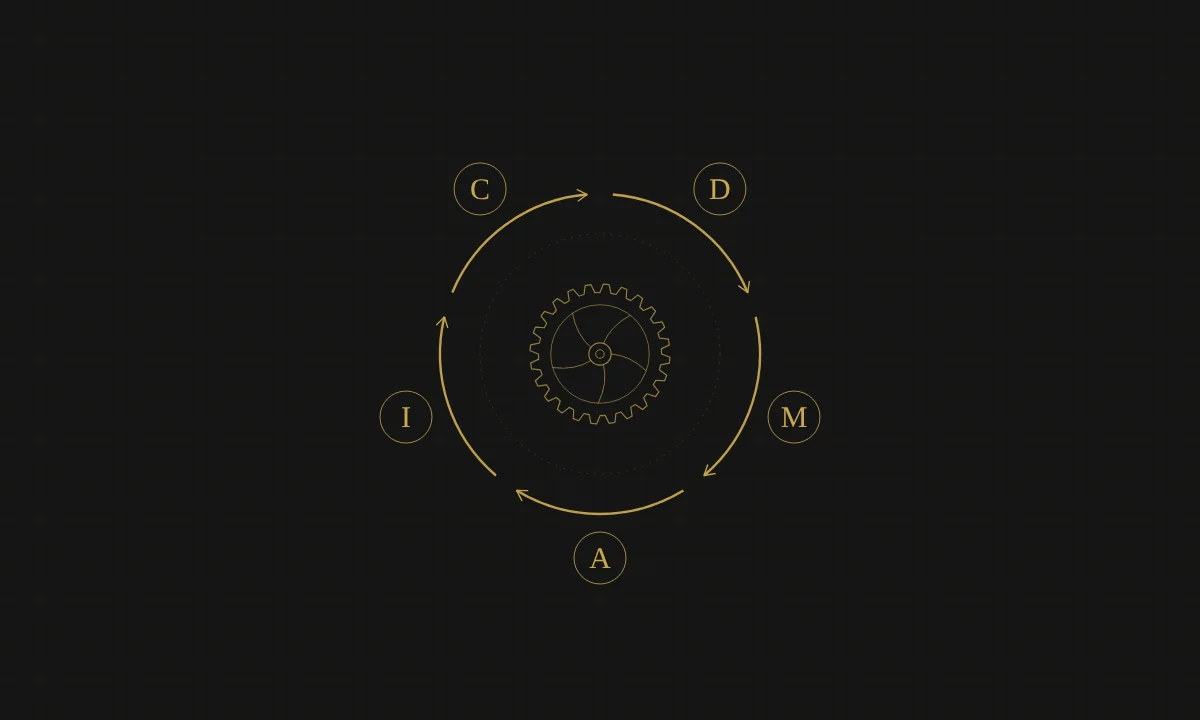
DMAIC is the backbone of Lean Six Sigma approaches. Its strength lies in its discipline: you do not look for a solution before understanding the problem, and you do not declare victory before checking that the result holds. Each stage has its tools; mixing them up often means skipping a stage.
- Define
Clarify the problem, the scope and the customer’s expectations. Tools: voice of the customer (VOC), SIPOC to map the process, 5W2H to frame the topic. - Measure
Establish the facts and the starting point. Tools: swimlane diagram, spaghetti diagram, VSM, tally sheets, OEE. - Analyse
Trace back to the root causes and rank them. Tools: 5 Whys, Ishikawa diagram, Pareto, Yamazumi for line balancing. - Improve
Choose and deploy the highest-impact solutions. Tools: FMEA, SMED, impact / effort matrix. - Control
Make the result last. Tools: standard work and TWI, audits, control charts.
The most common pitfalls
- Starting with “Improve”: the solution is chosen before the problem is understood.
- Measuring without making the data reliable: you end up analysing noise.
- Stopping at the first cause found, without verifying it with facts.
- Neglecting “Control”: without a standard or follow-up, the problem returns within months.
DMAIC is not a list of tools. It is an order of thinking.
In high-precision workshops, this rigour is all the more valuable because every defect is costly: rework can permanently damage a part. Taking the time to define and measure properly often saves weeks later on.
Key takeaways
- One tool per need, one stage after another.
- No solution without a proven cause.
- The Control stage makes the difference between a fix and a lasting improvement.